
Why Charleston’s Humidity Makes Crawlspace Encapsulation a Must, Not a Maybe
Table of Contents
- Charleston Is Beautiful. Its Humidity Is Not.
- What Humidity Actually Does to Your Crawlspace
- The “Stack Effect” and Why It Matters for Your Family
- How Other Climates Compare (And Why Charleston Is in a League of Its Own)
- Signs the Humidity Has Already Found Its Way In
- Why Encapsulation Is the Right Fix for This Specific Climate
- Frequently Asked Questions
- Let’s Take a Look Under Your Home
Charleston Is Beautiful. Its Humidity Is Not.
There is a reason people fall in love with Charleston. The history, the architecture, the food, the water. It is genuinely one of the most livable cities in the South. But if you own a home here, you already know that living in paradise comes with a price, and that price is humidity.
From late spring through early fall, Charleston air sits heavy and thick in a way that people from drier climates find genuinely shocking. The city regularly ranks among the most humid metros in the entire United States, with relative humidity averaging above 75 percent through the summer months. Factor in the proximity to the Atlantic coast and the tidal wetlands that surround so much of the Lowcountry, and you have a moisture environment unlike almost anywhere else in the country.
For homeowners, that humidity is not just uncomfortable. It is actively working against your home every single day. And nowhere does it do more damage than in the one place most people never think to check: the crawlspace.
What Humidity Actually Does to Your Crawlspace
Here is a simple way to understand what is happening under your home. Warm, humid air holds a lot of moisture. When that air contacts a cooler surface, like the soil under your house or the wood beams above it, that moisture drops out of the air and condenses onto whatever surface is nearby.
This happens constantly in an unencapsulated crawlspace. The ground itself releases moisture upward through a process called soil vapor transmission. That moisture then rises, condenses on your floor joists and subfloor, and sits there. Day after day. Season after season.
Wood that stays damp long enough begins to soften. Softwood becomes a feeding ground for mold, which can take hold in as little as 24 to 48 hours under the right conditions. And in a Charleston crawlspace during summer, the conditions are almost always right.
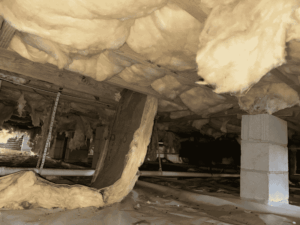
Beyond the wood itself, the insulation batts that many older homes have stapled between floor joists absorb moisture and sag. Once insulation gets wet, it loses its effectiveness and becomes another place for mold to grow. What started as a humidity problem becomes a structural and air quality problem faster than most homeowners expect.
The “Stack Effect” and Why It Matters for Your Family
This is the part that most people do not realize until someone explains it to them directly.
Your home breathes. Warm air inside your house rises and escapes through the upper levels, which creates a slight negative pressure at the bottom of the home. To equalize that pressure, air is pulled in from below, from the crawlspace, up through gaps in the subfloor, around pipes, through electrical penetrations, and into your living space.
This is called the stack effect, and it means that whatever air quality exists in your crawlspace, good or bad, is directly influencing the air your family breathes inside the home.
Yahel Kama, owner of Emerald Home Solutions, explains it this way: “A lot of our customers call us because someone in the family has been dealing with allergies or sinus issues that just never go away. They have had the HVAC serviced, they have changed air filters, they have done everything right inside the house. But when we get under there and take a look, the crawlspace tells the whole story. Mold spores, musty air, elevated humidity. It was coming up from below the whole time.”
In a city like Charleston where you are running the air conditioning for eight or nine months a year, the stack effect is almost always active. That makes the air quality in your crawlspace a year round concern, not just a seasonal one.
How Other Climates Compare (And Why Charleston Is in a League of Its Own)
To put this in perspective, consider that building science organizations and moisture experts typically flag areas with average annual relative humidity above 60 percent as high risk for crawlspace moisture problems. Charleston regularly exceeds that threshold by 15 to 20 percentage points.
Cities in the Southwest, the Midwest, and even much of the Mid Atlantic have crawlspace moisture concerns, but they also get seasonal dry spells that give wood and materials a chance to dry out. Charleston does not really get that reprieve. The combination of heat, coastal moisture, and the surrounding marshlands creates a baseline humidity that simply does not let up.
That is why encapsulation strategies that work in other parts of the country are often not enough here. A thin vapor barrier that might be adequate in a drier Southern city falls short in the Lowcountry. A full encapsulation with an active dehumidifier is the standard that actually holds up in this specific climate.
Signs the Humidity Has Already Found Its Way In
If you are reading this and wondering whether your crawlspace has already been affected, here are the most common signs Charleston homeowners report before they call us.
Musty or earthy smells inside the home
This is the most common first sign. If rooms near the floor level have a persistent musty odor that you cannot trace to anything obvious, the crawlspace is a very likely source.
Floors that feel soft, springy, or uneven
When subfloor panels or floor joists absorb enough moisture over time, they begin to lose structural integrity. Soft spots underfoot are a warning sign that should not be ignored.
Elevated indoor humidity levels
If your home feels clammy even with the air conditioning running, or if you notice condensation on windows and pipes, ground moisture from the crawlspace may be contributing.
Increased allergy or respiratory symptoms
Mold spores are invisible but very real. If family members are experiencing more congestion, coughing, or allergy flare ups than usual, indoor air quality is worth investigating.
Visible rust or corrosion on metal components
HVAC equipment, ductwork, and pipe fittings in or near the crawlspace can show rust from persistent moisture exposure before the damage becomes visible elsewhere.
If any of these sound familiar, it is worth having your crawlspace professionally inspected. Many of these problems are still very correctable at early stages.
Why Encapsulation Is the Right Fix for This Specific Climate
There are a few different approaches to crawlspace moisture management, and the right one depends heavily on where you live. Ventilated crawlspaces, which is the older standard where vents allow outside air to flow through, are almost universally a bad idea in high humidity climates. Bringing in Charleston summer air to dry out a crawlspace is like trying to dry a towel in a steam room.
A fully encapsulated crawlspace, by contrast, is sealed from the outside environment and conditioned from within. A quality vapor barrier on the floor and walls stops ground moisture from entering. Sealed vents stop humid outside air from entering. A dedicated crawlspace dehumidifier actively removes any moisture that does build up inside the sealed space, maintaining safe humidity levels year round.
For a Lowcountry home, this combination is not overkill. It is exactly the right level of protection for the environment your home actually lives in. The goal is a crawlspace that stays consistently between 50 and 60 percent relative humidity, which keeps wood safe, prevents mold growth, and protects the air quality of your entire home.
Frequently Asked Questions
1. Is Charleston’s humidity really that much worse than other Southern cities?
Yes, meaningfully so. Cities like Atlanta or Charlotte have humidity concerns, but they also sit further inland and at higher elevations. Charleston’s coastal position and surrounding tidal wetlands keep ground level moisture elevated in a way that is genuinely in a category of its own for the Southeast.
2. My home has vents in the crawlspace. Isn’t that supposed to let moisture out?
This was the building standard for decades, and it made sense in drier climates. In a high humidity area like Charleston, those vents bring in more moisture than they release. Sealing them is a key part of a proper encapsulation.
3. How often does the dehumidifier need to be maintained?
Most crawlspace dehumidifiers need the collection bucket emptied or the drain line checked periodically, and filters cleaned every few months. Some systems drain automatically. An annual service check keeps everything running efficiently.
4. Can I just run a regular household dehumidifier in my crawlspace?
Standard household dehumidifiers are not designed for the temperature ranges and moisture levels found in crawlspaces. They tend to fail early and do not move enough air for the space. Crawlspace specific units are built for those conditions and are worth the investment.
5. Will my homeowner’s insurance cover any of this?
Most standard policies do not cover moisture damage that develops gradually over time. Some policies may cover sudden events like a pipe burst. It is always worth checking with your provider, but encapsulation is typically an out of pocket investment in your home’s long term health.
Let’s Take a Look Under Your Home
If you live in Charleston, Mount Pleasant, Summerville, Goose Creek, or anywhere in the Lowcountry, your crawlspace is dealing with conditions that demand attention. Ignoring it is not a neutral choice. Moisture builds over time, and what starts as a humidity problem becomes a structural one if it goes long enough.
The team at Emerald Home Solutions has inspected and encapsulated crawlspaces all across the Charleston area. We will give you an honest assessment of what is going on under your home and a clear picture of what it takes to fix it.