The Hidden Cost of an Unencapsulated Crawlspace in the Lowcountry
Table of Contents
- The Cost You Do Not See Coming
- Structural Damage: When Moisture Meets Wood
- Mold Remediation: The Bill Nobody Wants
- What It Does to Your Energy Costs Every Month
- The Home Sale You Almost Lost
- Health Costs That Never Get Traced Back to the Crawlspace
- So What Does Encapsulation Actually Cost?
- Frequently Asked Questions
- Stop Paying the Hidden Tax on Your Home
The Cost You Do Not See Coming
Most homeowners think about their crawlspace the same way they think about their attic or their utility room. Out of sight, out of mind. As long as nothing is obviously broken, there is no reason to worry about it.
That line of thinking is expensive in any market. In the Lowcountry, it can be financially devastating.
The Charleston area is one of the most moisture aggressive environments in the entire country. High humidity, coastal air, surrounding marshland and tidal wetlands, and a climate that rarely gives homes a real dry spell to recover. When you have a crawlspace sitting open to all of that, unprotected and unmanaged, it is not a question of whether damage is happening. It is a question of how much has already accumulated and what it is going to cost to deal with it.
The frustrating part is that none of this damage announces itself. It builds quietly, underneath your floors, out of view, until the bill arrives. And by then, the numbers are almost always higher than they would have been if the crawlspace had been properly encapsulated from the start.
This post breaks down exactly what that bill tends to look like for Lowcountry homeowners.
Structural Damage: When Moisture Meets Wood
The most serious and most expensive consequence of an unencapsulated crawlspace is structural damage. The floor joists, rim joists, sill plates, and subfloor panels that hold your home up are almost always wood. And wood, when it stays wet long enough, does not hold up.
Moisture from the soil below and humid air from outside work together in an unencapsulated crawlspace to keep wood surfaces damp for months at a time. Over a period of years, that persistent dampness leads to wood rot. Rotted joists lose their load bearing capacity. Subfloor panels soften and begin to fail. In serious cases, the structural integrity of the entire floor system is compromised.
Replacing floor joists is not a small job. In the Charleston area, homeowners dealing with moderate to significant joist damage routinely face repair estimates in the range of $5,000 to $15,000 or more, depending on how many joists are affected and how accessible the crawlspace is. In cases where the damage has spread to sill plates or rim joists, costs climb higher. If the subfloor itself needs replacing, that often means pulling up finished flooring above it as well, which adds another layer of cost.
Yahel Kama, owner of Emerald Home Solutions, has seen this scenario play out more times than he can count across the Charleston area. “We get called in because someone noticed soft spots in their floor or a door that stopped closing right. When we get under there, we find rot that has been building for years. The homeowner had no idea. The crawlspace looked fine from the access door. You really have to get in there and look closely.”
The hard reality is that wood rot does not stop on its own. It keeps spreading as long as the moisture source keeps feeding it. Every month that an unencapsulated crawlspace is left unaddressed in a Lowcountry home is another month the damage is compounding.
Mold Remediation: The Bill Nobody Wants
Structural repair is the most expensive single outcome, but mold remediation is the one that catches homeowners most off guard because it can happen much faster.
Under the right conditions, mold can begin colonizing a surface within 24 to 48 hours of sustained moisture exposure. In a warm, damp, unventilated crawlspace during a Charleston summer, those conditions are almost always present. Mold does not need much to get started. It just needs moisture, an organic surface like wood or paper faced insulation, and time.
By the time mold in a crawlspace is serious enough to cause symptoms in the home above, it has often spread significantly. Professional mold remediation in a crawlspace setting in the Charleston area typically runs between $2,000 and $6,000 for moderate cases. More severe infestations involving large surface areas, contaminated insulation, and the need for antimicrobial treatment and containment can push costs considerably higher.
And here is the part that makes it even more frustrating: mold remediation alone does not solve the problem. If the moisture source is not addressed at the same time, mold will return. So a homeowner who pays for remediation without encapsulating the crawlspace is likely to be paying that bill again in a few years.
What It Does to Your Energy Costs Every Month
This one is less dramatic than rot or mold, but it adds up steadily over time in a way that most homeowners never connect back to their crawlspace.
An unencapsulated crawlspace allows outside air and ground moisture to flow freely into the space beneath your home. That moisture loaded air then rises into your living space through the stack effect, adding to the humidity load your HVAC system has to manage. Your air conditioner is not just cooling your home. It is also fighting the moisture coming up from below.
In Charleston, where air conditioning runs hard for eight or nine months out of the year, that extra load is not trivial. Studies from building science researchers have found that properly encapsulating a crawlspace can reduce HVAC energy consumption by 15 to 25 percent in humid climates. On a monthly cooling bill of $200 to $300, which is very common for Charleston area homes in summer, that represents real money every single month.
Over the course of five years, the energy savings alone from a proper encapsulation can easily offset a significant portion of the installation cost. Most homeowners who encapsulate report noticing the difference on their utility bills within the first full summer season.
The Home Sale You Almost Lost
Charleston’s real estate market has been competitive for years, and buyers today are more informed than ever. Home inspectors routinely go into crawlspaces, and what they find there can kill a deal fast or at minimum give buyers ammunition to demand price reductions.
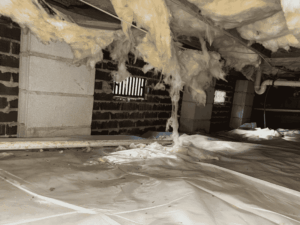
An unencapsulated crawlspace with visible moisture damage, mold, deteriorated insulation, or wood rot can trigger repair demands, further inspection requirements, or outright buyer walkouts. In a market where every negotiating point matters, a crawlspace problem is one of the most avoidable liabilities a seller can face.
Real estate professionals in the Charleston area consistently note that an encapsulated crawlspace is a genuine selling point. It removes a common inspection red flag, signals that the home has been well maintained, and gives buyers confidence. The presence of a clean, encapsulated crawlspace with a working dehumidifier is the kind of detail that shows up in listing descriptions for good reason.
Health Costs That Never Get Traced Back to the Crawlspace
This one is harder to put a dollar figure on, but it is real and it affects Lowcountry families more often than most people realize.
The stack effect means that air from your crawlspace is constantly being drawn up into your living space. When that crawlspace contains mold spores, elevated humidity, or pest activity, all of that comes up with it. Mold exposure has been linked to respiratory symptoms, chronic sinus issues, allergy flare ups, headaches, and in sensitive individuals, more serious health effects.
Families who have been dealing with persistent allergy symptoms or respiratory issues that do not respond to normal interventions often discover after encapsulation that the crawlspace was the source of the problem. The health improvement after encapsulation can be noticeable within weeks. There is no clean way to calculate what that is worth, but it matters.
So What Does Encapsulation Actually Cost?
After reading all of the above, the cost of a proper encapsulation starts to look very different than it might have seemed at first.
In the Charleston area, a full crawlspace encapsulation typically runs between $3,000 and $8,000 depending on the size of the space, the condition it is in, and the equipment included. For most homes, the investment pays for itself through a combination of energy savings, avoided repair costs, and the protection it provides to your home’s value and your family’s health.
Compare that to the realistic cost of ignoring it: floor joist replacement at $5,000 to $15,000, mold remediation at $2,000 to $6,000, ongoing higher energy bills, and potential complications at the time of sale. The math is not particularly close.
Frequently Asked Questions
1. Can I just check my crawlspace myself to see if there is a problem?
You can take a look, but most homeowners are not sure what they are looking for. Moisture damage, early stage mold, and compromised wood are not always obvious to an untrained eye. A professional inspection is worth it, especially since many companies in the Charleston area offer them at no charge.
2. How quickly can damage develop in a Lowcountry crawlspace?
Faster than most homeowners expect. In Charleston’s climate, mold can begin within 48 hours of sustained moisture exposure. Structural softening from wood rot can become significant within a few years in a persistently damp crawlspace.
3. Does a newer home need encapsulation too?
Yes. Newer construction does not necessarily mean better crawlspace protection. Many newer homes in the Charleston area still have unencapsulated crawlspaces by default. The climate affects them the same way it affects older homes.
4. If I already have a vapor barrier, am I protected?
A basic vapor barrier offers some protection but it is not the same as a full encapsulation. If the vents are still open and there is no active dehumidification, ground moisture and outside air are still getting in. A true encapsulation seals the entire space and manages moisture actively.
5. What is the first step if I am concerned about my crawlspace?
Schedule an inspection. A qualified contractor can assess exactly what is going on under your home, identify any existing damage, and give you an honest picture of what is needed. You cannot make a good decision without knowing what you are actually dealing with.
Stop Paying the Hidden Tax on Your Home
Every month that passes with an unprotected crawlspace in a Lowcountry home is a month that moisture, mold, and structural stress are quietly building up. It is a cost that does not show up on any bill until it does, and by then it is always higher than it needed to be.
The team at Emerald Home Solutions works with homeowners across Charleston, Mount Pleasant, Summerville, Goose Creek, and the surrounding Lowcountry communities. We will take an honest look at your crawlspace and give you a clear picture of where things stand.
Contact us today to schedule your free crawlspace inspection.