Rodent Droppings in Attic Insulation: What Charleston Homeowners Need to Do Right Away
Why this is more than a pest problem — and the right way to handle it without making things worse
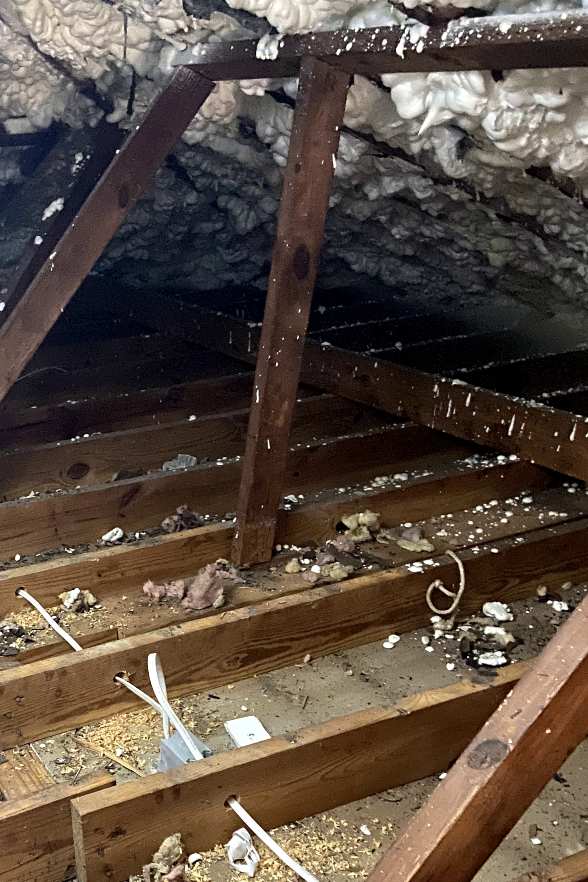
Rodent droppings in attic insulation are not just unsightly — they carry real health risks and require professional remediation. Emerald Home Solutions, Charleston, SC.
1 How to Identify Rodent Droppings in Attic Insulation
Not all droppings look the same, and identifying what you are dealing with helps determine the scope of the problem. The three most common culprits in Charleston-area attics are house mice, roof rats, and squirrels — each leaves distinctly different evidence.
Mouse Droppings
Small, rod-shaped, about a quarter inch long with pointed ends. Mouse droppings are by far the most common form found in Charleston attics. A single mouse can produce dozens per day, so even a small infestation generates a lot of visible material quickly. They are usually scattered along beams, near nesting sites, and in the troughs of the insulation itself.
Rat Droppings
Larger, about half an inch to three-quarters of an inch long, with blunter ends. Roof rats are common in the Lowcountry and tend to leave droppings in concentrated piles rather than scattered around. If you see significantly larger droppings, you are dealing with a more serious infestation.
Squirrel Droppings
Roughly the size of rat droppings but lighter in color and often more uniform in shape. Squirrels in attics are extremely common in Charleston neighborhoods with mature oaks and pines — areas like Mount Pleasant, James Island, and parts of West Ashley. Squirrel infestations also cause significant insulation displacement from their nesting behavior.
Regardless of which species you identify, the response is largely the same. The droppings need to be removed safely, the affected insulation has to come out, the attic has to be properly sanitized, and the entry points have to be sealed.
2 Why This Is More Than a Pest Problem
Most homeowners think of rodents in the attic as a pest control issue. The truth is that the pest control side is only half of it. The droppings themselves are the bigger long-term concern, and they need a different kind of professional to address them properly.
Hantavirus and Other Pathogens
Rodent urine and droppings can carry hantavirus, which causes hantavirus pulmonary syndrome (HPS) — a potentially fatal respiratory illness. The CDC has confirmed hundreds of cases nationwide since 1993. Infection occurs primarily through inhaling airborne particles when droppings are disturbed. This is exactly what happens when a homeowner climbs into an attic and starts moving things around without proper containment.
Salmonella and Leptospirosis
Beyond hantavirus, rodent droppings can carry salmonella, leptospirosis, and various other bacteria and parasites that affect humans. None of these require direct contact to cause a problem — airborne or surface contamination is enough.
Allergens and Indoor Air Quality
Even if no specific pathogen is present, dried rodent waste contains proteins that act as powerful allergens, particularly for people with asthma or respiratory sensitivities. Through the stack effect — warm air rising from your living space and pulling air up from the attic — those allergens cycle into the air your family breathes every day.
Health Warning: Disturbing rodent droppings in attic insulation without proper containment and personal protective equipment is the single biggest risk associated with this problem. The pathogens become airborne in seconds, and a single deep breath in a contaminated attic can be enough to cause exposure.
3 Why Charleston Attics See This So Often
A few factors make this problem more common in the Lowcountry than in many other parts of the country. Charleston’s mild climate means that rodent populations stay active year-round rather than going dormant during winter. Mature tree canopies in established neighborhoods give squirrels and roof rats easy access to roof lines. Older homes with original construction often have entry points that newer construction would have sealed off.
The proximity to marshland and wooded greenbelts in many Charleston neighborhoods also matters. Areas like Daniel Island, parts of Mount Pleasant, Sullivan’s Island, and the older sections of West Ashley have rodent pressure that homeowners in inland states simply do not experience. Combined with the older raised-roof construction common across Lowcountry homes, attic intrusion becomes a matter of when rather than if.
The other factor is detection time. Charleston attics are uncomfortable to enter for most of the year — too hot in summer, too humid in shoulder seasons. Most homeowners avoid going up there for months at a time, which gives any infestation more time to develop and more droppings to accumulate before discovery.
| Species | Common in Charleston Attics | Risk Level for Contaminated Insulation |
|---|---|---|
| House mouse | Very common | High — large dropping volume per day |
| Roof rat (black rat) | Common in coastal areas | Very high — larger droppings, hantavirus carriers |
| Eastern gray squirrel | Very common | High — heavy nesting and insulation displacement |
| Flying squirrel | Occasional | Moderate — colony nesters, hard to detect |
| Raccoon | Occasional | Very high — large waste, parasites, leptospirosis |
4 Why You Should Never Vacuum or Sweep Droppings
This is the single most important point in the entire article. The CDC explicitly warns against sweeping or vacuuming rodent droppings under any circumstances. Doing so aerosolizes pathogens that may have been dormant on dry surfaces, sending them directly into the air where they can be inhaled.
A standard household vacuum, even one with a HEPA filter, is not the right tool for this. The agitation of the brush head and the airflow through the unit can release contaminated particles into the room while pulling material into the vacuum bag or canister. Even worse, the contaminated vacuum then needs to be disposed of safely, which most homeowners do not realize until it is too late.
The right approach involves wetting the contaminated material with an EPA-registered disinfectant or a properly diluted bleach solution, allowing contact time, and then removing it without disturbance. This is the standard for safe handling outlined in CDC guidance, and it is the protocol professional remediation crews follow.
5 The Right Way to Handle Rodent Droppings in Attic Insulation
Professional attic remediation follows a structured process designed to remove contamination safely while protecting both the workers and the home’s occupants. Here is what proper handling actually looks like.
- Containment. The work area is sealed off from the rest of the home with plastic barriers, and the path from the attic access to the exit is fully covered. Negative air pressure is established where needed to prevent airborne contamination from migrating.
- Personal protective equipment. Technicians wear N95 or higher respirators, sealed eye protection, gloves, and disposable coveralls. This is the same level of PPE used for asbestos and mold remediation work.
- Disinfection before removal. Affected areas are misted with EPA-registered disinfectant and allowed to soak for at least 15 minutes before any material is touched. This neutralizes pathogens before they can become airborne.
- Insulation removal. Contaminated insulation — whether blown-in cellulose, fiberglass batts, or older materials — is bagged and removed in its entirety. Spot cleaning is not appropriate for rodent droppings in attic insulation because contamination is rarely confined to the visible area.
- Surface sanitization. Joists, rafters, and the underside of the roof deck are cleaned and treated with antimicrobial products to neutralize any pathogens that may have transferred from droppings or urine.
- Entry point sealing. Every identified or suspected access point — soffit gaps, roof penetrations, foundation vents, eaves — is sealed with appropriate materials to prevent reinfestation.
- Replacement insulation. New insulation is installed only after the attic is verified clean. Installing over contaminated material would simply trap the problem in the home.
You can read about our full process and certifications on our attic cleanup in Charleston service page.
6 Common Mistakes That Make Things Worse
Several well-intentioned homeowner responses end up causing more harm than good. These are the ones we encounter most often when called in after a DIY attempt.
Treating the Mice Without Sealing the Entry Points
Pest control alone — traps, bait stations, exterminators — kills the current occupants but does nothing to keep the next ones out. Within weeks of clearing one infestation, another usually moves in through the same access points.
Skipping the Insulation Replacement
Some homeowners assume that once the rodents are gone and the obvious droppings are removed, the issue is resolved. The reality is that contaminated insulation continues to release allergens, pathogens, and odors for as long as it stays in place. The affected material cannot be effectively spot-cleaned — it has to come out.
Ignoring the Air Quality Side
The droppings are a problem before they are physically removed because of how the stack effect circulates particles from the attic into living spaces. Families dealing with persistent allergies or unexplained respiratory symptoms often find that their issues resolve only after the contaminated attic is fully remediated.
Using the Wrong Cleaning Methods
Sweeping, dry vacuuming, or attempting to wipe up dried droppings without first wetting them with disinfectant aerosolizes pathogens. This is the most dangerous DIY mistake and the one most often made by homeowners trying to handle the issue themselves.
7 When to Call a Professional
Some attic situations can wait for routine service scheduling. Others should not. The following signs warrant a same-week call.
- Visible rodent droppings anywhere in your attic, even in small amounts
- A persistent smell — musty, ammonia-like, or urine-like — coming through your ceiling or vents
- Scratching, rustling, or scurrying sounds in the attic, especially at dawn or dusk
- Visible chew marks or shredded material on insulation, cardboard, or storage items
- Yellow-brown stains on attic insulation that were not there at the last inspection
- Family members experiencing allergy or respiratory symptoms that worsen at home
- Recent rodent activity confirmed by pest control but no insulation replacement has been done yet
- The home is older and the attic has not been professionally inspected in five or more years
Charleston homeowners often discover signs of attic contamination when they go up to retrieve seasonal decorations or storage items. If that describes you, treat the discovery as a real call to action rather than something you can handle on the next free weekend.
Attic Cleanup Across the Lowcountry
Emerald Home Solutions provides professional attic cleanup in Charleston and full insulation removal and replacement throughout the surrounding Lowcountry communities:
Frequently Asked Questions — Rodent Droppings in Attic Insulation
Common questions from Charleston-area homeowners about attic contamination, safe cleanup, and replacement.
Dangerous enough that the CDC publishes specific cleanup protocols for them. The primary risk is hantavirus pulmonary syndrome, which is rare but has a fatality rate above 30 percent when contracted. Secondary risks include salmonella, leptospirosis, and significant allergen exposure. The risk is highest when the droppings are dry and get disturbed — which is exactly what happens when a homeowner attempts to clean them up without proper protection.
No. Spot cleaning misses urine contamination that has soaked deeper into the insulation than visible droppings indicate, and it does not address the allergens and odors that continue to release from contaminated material. Industry standard and CDC guidance both recommend full removal of affected insulation rather than spot treatment. In most attics, contamination is more widespread than the visible droppings suggest.
In the Charleston area, full attic cleanup with insulation removal and replacement typically runs between $2,000 and $7,000 depending on attic size, level of contamination, type of insulation being removed, and accessibility. Smaller attics with limited contamination may be on the lower end. Larger attics with severe infestation history, multiple species, or asbestos-containing legacy materials run higher. Detailed quotes always require an in-person inspection.
It depends. Most standard South Carolina policies exclude rodent damage as a maintenance issue rather than a covered peril. However, if the damage stems from a sudden event — for example, a tree limb that created a roof opening allowing wildlife entry — there may be coverage for the damage itself. We can provide detailed inspection documentation that supports an insurance claim where one is applicable.
For most Charleston-area homes, the full process — containment setup, contaminated insulation removal, sanitization, entry point sealing, and new insulation installation — takes one to three days. Larger homes or attics with severe contamination can take longer. New insulation installation is usually done immediately after cleanup is complete, though it can be a separate appointment if preferred.
Most homeowners notice three things within the first few weeks. Any musty or ammonia-like smell that had been coming through ceilings or vents goes away. Allergy and respiratory symptoms among family members often improve noticeably, sometimes dramatically. And the upstairs of the home feels more comfortable, since the new insulation is properly performing at its rated R-value rather than the diminished value of contaminated, compressed material.
The single most important step is sealing every potential entry point during the cleanup process. Rodents only need a hole the size of a dime to get in. We document and seal every gap, soffit penetration, eave opening, and vent point during remediation. Combined with annual pest control monitoring, this prevents the cycle from repeating. Skipping the entry point sealing step is the most common reason homeowners end up dealing with rodent droppings in attic insulation again a year or two later.
Discovered Something in Your Attic? Don’t Disturb It.
If you have just discovered evidence of rodent activity in your attic — droppings, smells, sounds, or visible damage — the safest next step is a professional inspection. Emerald Home Solutions provides thorough attic assessments and full cleanup services throughout Charleston and the Lowcountry.
📞 Call 843-350-5035 Request a Free Inspection